Stop Dry Rot from spreading. Dry Rot Barrier Emulsion Paint for protection of surfaces. No odour, permanent protection.
Dry Rot cannot spread across our Dry Rot Barrier Paint, but it can travel over other preservative treatments, so protect the back of skirting boards, inside door frames, behind window linings and the ends of floor joists, in other words anything that has been in contact with Dry Rot.
Click here to see Dry Rot Paint, check prices and Order in our Dry Rot Shop.
Free Telephone support during Dry Rot treatment - from our qualified expert
There are two main types of wood rotting fungus that attack damp timber in houses and commercial buildings, Wet rots and Dry rot. To buy rot treatment you need to know the difference between a variety of Wet rots and the unique fungus, Dry rot (Latin name - Serpula lacrymans). This is because Dry rot can travel across dry areas made of any material to reach untreated wood to eat. Wet rots are confined to the wet areas only. However, areas of Wet rot that dry out can easily turn into Dry rot, as the dampness level falls into the range that Dry rot prefers.
We provide Free Advice to make sure that the diagnosis of Rot is correct and that we offer the correct chemical treatment for wood preservation and masonry (e.g. brick, stone, mortar) sterilisation.
All wood rots indicate a dampness problem. Damp in walls, floors and roofs must be tracked back to source and the cause of the damp treated (see www.dampness-info.co.uk).
Rots are woodland fungi frequently found in houses and commercial buildings where dampness has entered, usually as the result of leaking gutters, downpipes, drains or roofing. They requires an initial moisture content of about 18% in wood, but Dry rot, unlike the family of Wet Rots, can spread across dry areas and across surfaces treated with wood preservatives. This ability, unique to Dry Rot, to travel outside of the damp area makes it dangerous to wood in buildings. You can treat masonry and timbers with wood preservatives to perfection, but a small pocket of Dry Rot can still be capable of emerging across the treated area looking for new timber to attack.
Sometimes such an outbreak can emerge long after initial treatment, as the result of a new leak into the treated area. The treatment chemical is then over diluted by the water added from the new leak. This dilution effect occurs because Rot treatments have to be water soluble in order to penetrate damp masonry and timber.
The answer to this problem is called 'Dry Rot Barrier Paint'. This is an emulsion paint containing Polyphase, a fungicide which is incorporated in the paint film when it dries - amazingly Rot will not walk across this coating! Dry Rot will happily walk across other types of chemical treatment when dry, sometimes leading to fresh outbreaks many metres from the original treated area.
This effect has been tested by the Government backed Building Research Establishment (B.R.E.) - the 'Gold Standard' in testing facilities for the Building industry. The paint can be used on timber and masonry, and it creates a 'No Go Zone' for Rot, regardless of future dampness problems.
Click here to see Dry Rot Paint, check prices and Order in our Dry Rot Shop.
Areas to treat with Dry Rot Paint
Back of skirting boards, architraves, door linings, joist or beam ends, window frame reveals, under and between floor masonry.
How to test for dampness potentially causing future Dry Rot
Use a Damp Testing Meter on skirting boards, architraves, door linings, joist or beam ends, window frame reveals, under and between floor and masonry, looking for readings over 18% in wood or over 2% in masonry, using the different scales on the Meter (see Meters on www.dampness-info.co.uk)
Click here to see Dry Rot Paint, check prices and Order in our Dry Rot Shop.
Free adviceWhat is Dry Rot, how does Dry Rot spread, how to treat Dry Rot and other wood rots, how to prevent Dry Rot.
Call our experts David, Kathy or Angela to discuss your house fungus on 01626 872886
Diagnose Rots - including Dry Rot
1. Wet looking, dark, water stained timber, soft and damp to touch or probe - Wet rot symptom
2. Wood breaking into lots of small cubes - Wet rot 'cubing' symptom
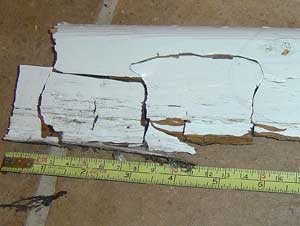
3. Wood breaking into larger cubes, fewer but larger cracks across the grain - Dry rot 'cubing' symptom
4. Strands, like plant roots, brilliant white, dark brown, or black (flexible when dry) - Wet rot 'hyphae' symptom
5. Strands, like plant roots, dirty silver grey (brittle when dry) - Dry rot 'hyphae' symptom
6. Skin, brilliant white, dark brown or black - Wet rot 'mycellium' symptom
7. Skin, off white to silver grey, like felt - Dry rot 'mycellium' symptom
8. Flat or lumpy mushroom, brilliant white, pale yellow, brown - Wet rot 'fruiting body' symptom
9. Flat mushroom, brilliant rust red with rust red dust (spores) on surroundings - Dry rot unique 'fruiting body' symptom
10. Pillows of off white fluffy growths - Dry rot unique symptom
11. Damp skirting boards or wooden boards crease inwards along the grain - Wet rot likely on the rear
12. Damp skirting boards or wooden boards curve outwards (convex) along the grain - Dry rot likely on the rear
Special features of Dry Rot Barrier Paint:
* highly visible white barrier coating, you can see that you are protected (most treatments are clear, so you cannot be sure they have been applied)
* low odour emulsion paint (low V.O.C.), odourless when dry, can be colour tinted or matched
* not affected by damp (even if adjacent wood treatments are diluted)
* easy to brush on
* low toxicity active ingredient, 48 hours re-entry or until dry
* non-flammable
Go to our Dry Rot Shop to view prices or place an Order
Click here to see Dry Rot Paint, check prices and Order in our Dry Rot Shop.
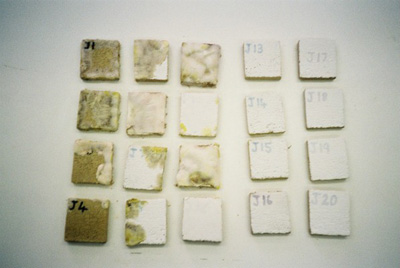
Independent Test of Dry Rot Barrier Paint:
Building Research Establishment (B.R.E. - Government backed test house)
Dry Rot Painted Panels (right hand two columns) tested against untreated
and ordinary painted panels (left hand three columns)
Click here to see Dry Rot Paint, check prices and Order in our Dry Rot Shop.
What is Dry Rot - pictures of Dry Rot - examples of where to use Dry Rot Paint
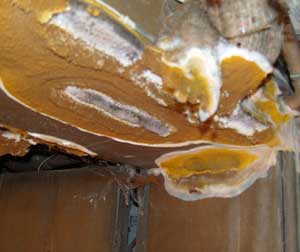
Mycelium 'skin' of Dry Rot on a floor. Fruiting Body of Dry Rot hidden in a void.
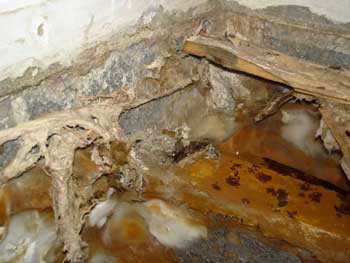
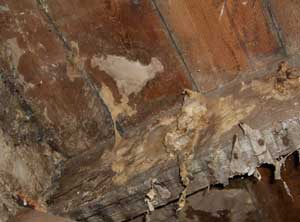
Mycellium 'skin' and spore brown dust. Skirting Board - Dry Rot 'cubing'.
Click here to see Dry Rot Paint, check prices and Order in our Dry Rot Shop.
How does Dry Rot spread - Dry Rot Paint prevents this spread
The strands of Dry Rot send out tiny, micro strands ahead of the main attack, looking for wood to eat - these are not visible to the naked eye - hence the need for treatment beyond the visible areas of wood decay. These strands can carry water within themselves, so they can 'walk' across dry areas and non-timber surfaces (plastic, metal, flooring) - hence the need for a barrier coating - Dry Rot Paint.
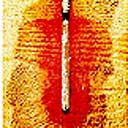
Curcumin Test - yellow dye turns red where Boron is spreading.
This picture shows how internal treatment with Boron Paste and a solid stick of Borate, the Boron Rod, can spread around the insertion point to protect timbers internally, an essential part of Dry Rot treatment in damp timbers close enough to an attack to be reached by the micro strands ahead of the main attack.
Technical Support for Dry Rot Paint
All PRS products are supported with Method Statements, Specifications and comprehensive technical support. Please ask for our technical department. Contact us aT: 01626 872886 or help@propertyrepairsystems.co.uk
Certificate of Product Guarantee for Dry Rot Paint
We offer a printed Certificate of Product Guarantee for individual properties, should you require one for your Bank, Building Society or house purchaser.
Call us for details on 01626 872886 .
Click to go to Dry Rot Technical Information.
Books - guides to Dry Rot, Wet Rot, Wood Boring Insects, Moulds and Damp
Buy Books
Buy Identifying Wood Boring Insects, Rots and Moulds: full colour: BRE.
£55.00 -

Identifying Dampness in Buildings: Coleman - buy the Reprinted Book
£9.97 -
Identifying Dampness in Buildings: Coleman - buy a direct Download
£5.99 -
Click here to see Dry Rot Paint, check prices and Order in our Dry Rot Shop.
Property Repair Systems,
T: 01626 872886
Site written by: David Moore
David Moore, B.A. (Hons.), C.T.I.S., C.R.D.S. Technical Author
Google+